In brief
A hardshell jacket is a weather-protection jacket whose outer fabric and seams are waterproof. As personal protective equipment, this property is tested to EN 343 or, in future, to EN ISO 24232 (harmonised since 4 September 2026) and stated as classes. For German emergency medical services (EMS), DGUV Rule 105-003 requires waterproofness class 3, breathability class 3 to DIN EN 343:2010 (Ret at most 20 m²·Pa/W) and sealed seams.
At a glance
- Term
- product name, not a standard term
- Protective function
- rain and wind; proven to EN 343 or EN ISO 24232
- Key values
- waterproofness Wp (Pa) and water vapour resistance Ret (m²·Pa/W)
- EMS requirement
- Wp class 3, Ret class 3 to DIN EN 343:2010 (at most 20 m²·Pa/W), sealed seams (DGUV Rule 105-003, 4.2.1)
- Warmth
- removable insulating liner recommended, Rct > 0.07 m²·K/W
- Visibility
- in EMS also high-visibility clothing to EN ISO 20471
- PPE category
- II (EU type-examination by a notified body)
- Distinction
- softshell jacket: more elastic, no declared EN 343 rain class (at Nitzsche)
Detailed definition
“Hardshell” is not a term defined in any standard; it is a product name used in the clothing trade. It refers to an outer jacket that keeps out rain and wind because both the outer fabric and the seams are waterproof. For personal protective equipment, the name does not matter, the proof does: whether a jacket protects against rain is tested to EN 343 and, in future, to its successor EN ISO 24232 (harmonised since 4 September 2026). The result is shown as a class for waterproofness (Wp) and for water vapour resistance (Ret) next to the rain pictogram on the label.
For German EMS, DGUV Rule 105-003, section 4.2.1, describes what a weather-protection jacket must deliver. Protective clothing should protect against wet, wind and cold while still letting water vapour escape. It requires waterproofness class 3 and water vapour permeability class 3. The rule refers to DIN EN 343:2010 (Ret class 3 = at most 20 m²·Pa/W). Under EN 343:2019 and EN ISO 24232, class 3 extends to 25 m²·Pa/W; only a Ret of at most 20 m²·Pa/W is therefore equivalent. Waterproofness applies to both the fabric and the seams; seams must be sealed with special seam tape. For the cold season, the rule recommends a zip-in insulating inner jacket with a thermal resistance Rct above 0.07 m²·K/W.
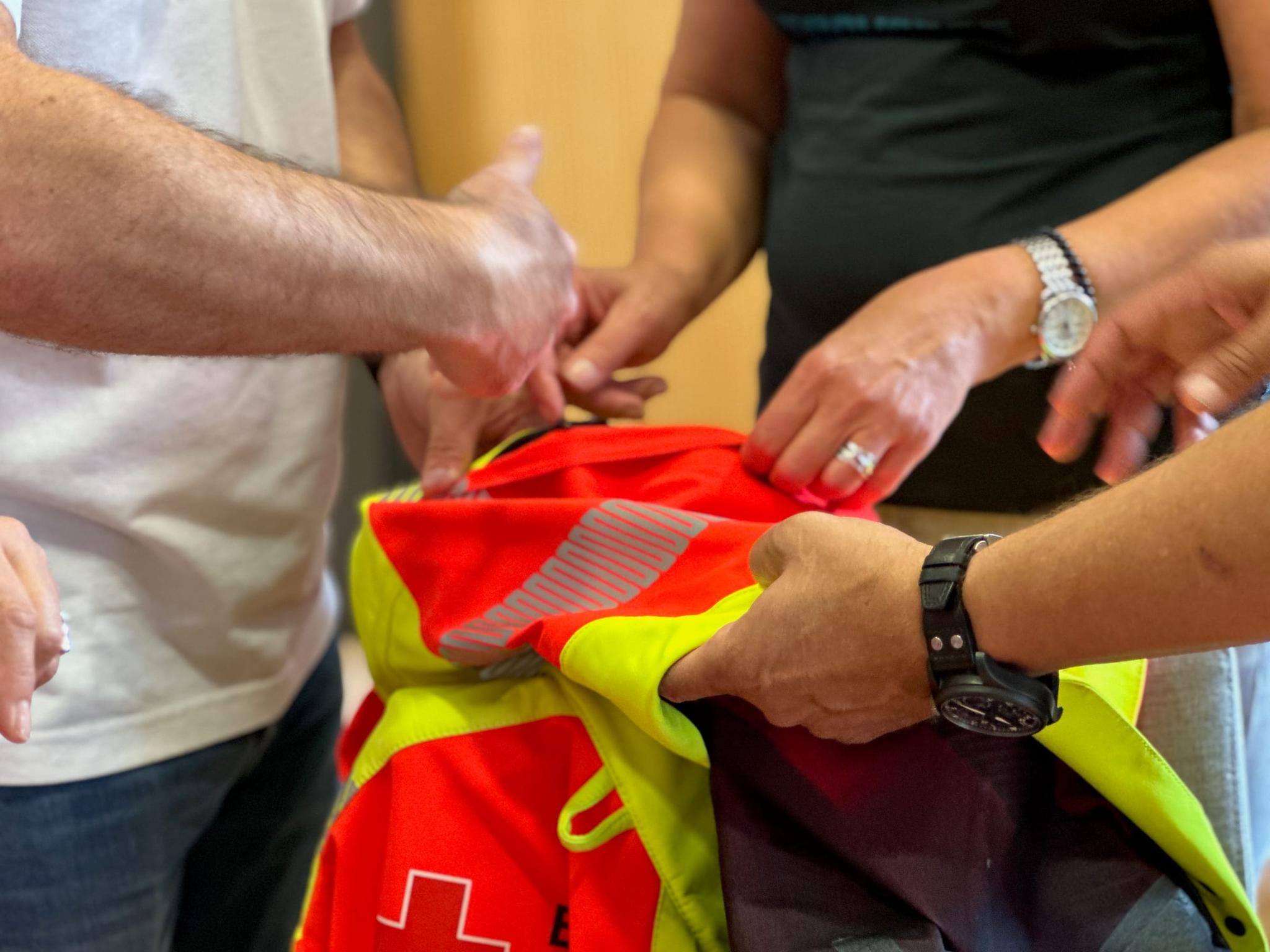
In EMS, a hardshell jacket is usually also high-visibility clothing under EN ISO 20471. DGUV Information 212-016 describes such clothing as a combination of rain protection and high-visibility clothing manufactured to both standards. The rain protection class and the high-visibility class are two separate figures and must not be confused.
In practice at Nitzsche
We make hardshell and weather-protection jackets for EMS in several versions. Our declarations of conformity for the “Hardshelljacken Titania” (14 February 2025) and the “Hardshelljacke BRK RD Bayern” (1 December 2025) each list EN ISO 20471, EN ISO 13688, EN 343 and DGUV Rule 105-003. Both refer to the same EU type-examination certificate VN605 250384 issued by the notified body OETI in Vienna (identification number 0534). They also name the conformity assessment procedure Module C2, meaning product checks supervised by OETI.
EN 343 is also listed in the declarations for the protective jackets with zip-in liner, the light 2-layer protective jackets, the protective jackets for Malteser, Wasserwacht, Rheinland-Pfalz/Ludwigshafen, Schleswig-Holstein and Bonn, and the Malteser blouson jacket. All our declarations state PPE category II.
The classes a specific jacket achieves are not stated in the declaration of conformity but on the label and in the type-examination certificate.
Frequently asked questions
Is every hardshell jacket waterproof in the sense of the standard?
No. “Hardshell” is a marketing term. A jacket only counts as rain-protection PPE if it has been tested to EN 343 or EN ISO 24232, holds an EU type-examination certificate and carries the rain pictogram with classes. Check the declaration of conformity and the label.
Why do sealed seams matter so much?
Every seam is an opening in the fabric. DGUV Rule 105-003 therefore requires waterproofness to apply not only to the fabric but also to the seams, and seams to be sealed with seam tape. Only then does the jacket stay waterproof over time.
Do I need a second jacket for winter?
DGUV Rule 105-003 recommends an optional zip-in inner jacket for thermal insulation in EMS jackets. The same outer jacket can then be used all year, with the liner added in cold weather. We offer protective jackets with a zip-in liner for this purpose.
Do I need high-visibility trousers with a hardshell jacket?
That depends on the high-visibility class. If the jacket alone reaches class 3 under EN ISO 20471, DGUV Rule 105-003 sets no further visibility requirements for the trousers worn with it. The class a jacket achieves is shown by the high-visibility pictogram on the label.
Sources (7)
This article gives a general overview. It does not replace the text of the standard or the risk assessment in your organisation. For any product, its declaration of conformity and the manufacturer's information are binding. If you notice a mistake, please let us know.